Getting Intensive on the Treadmill

I love High Intensity Interval Training (HIIT). Well, I love it when I’m not in the process of actually doing it! It is a fantastic way of improving sports performance in short periods of time.

I tried out a new protocol today, cribbed from ‘Referee Specific Training’, a presentation by Bryn Markham-Jones. You can find it on pages 17 and 18.

Here is my own summary, and I have put the timings differently to make it easier to follow when actually doing it.

WARNING: HIIT is, by definition, INTENSIVE! Be absolutely sure you are fit to do this. Check with your GP if required. It is also expected that you are fully warmed up before commencing this, as it STARTS with running fast.

Set treadmill inclination to suit your fitness.

00:00 – 18.5 km/h
00:30 – Jogging
01:30 – 16.5 – 17.5 km/h
02:30 – Jogging
03:30 – 16 – 17 km/h
05:00 – Jogging
06:00 – 15 – 16 km/h
08:00 – Jogging
09:00 – 16 – 17 km/h
10:30 – Jogging
11:30 – 16.5 – 17.5 km/h
12:30 – Jogging
13:30 – 18.5 km/h
14:00 – Jogging
15:00 – STOP.

REST 5 minutes. This is ONE SET. Repeat, to make a total exercise duration of 35 minutes.

Fun, huh? I made it through, although I went for a 0% incline and the ‘Jogging’ elements ended up mostly being ‘Walking recovery’ in all honesty. Need to step that up!

My own personal guideline for HIIT: “Do I feel like I might collapse if I do any more? Do I have a sense of euphoria for finishing?” Job done then!

Do you have any favourite interval training routines?
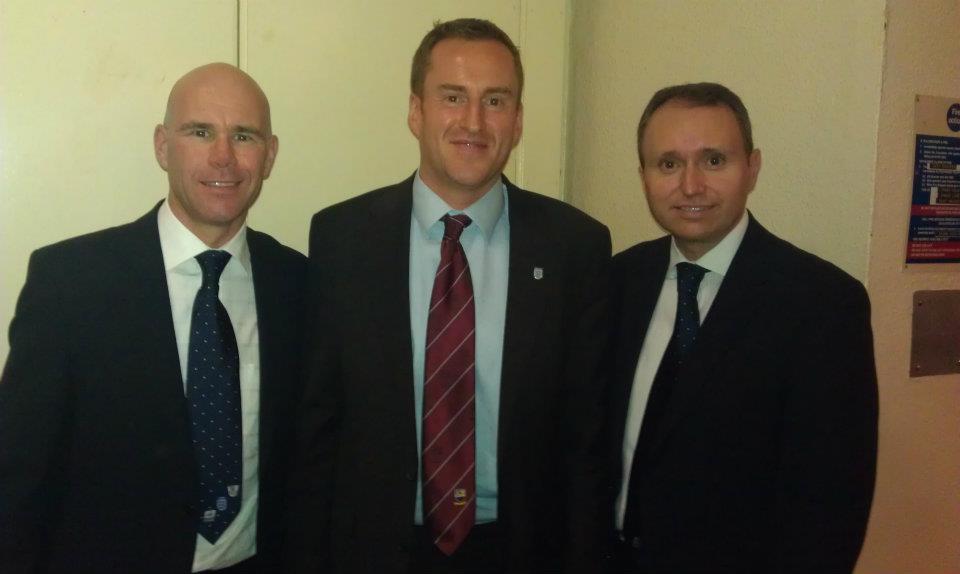
An evening with the World Cup Final Assistant Referees

I attended the Surrey FA RA-FA meeting last night, where Darren Cann and Mike Mullarkey gave their story of their involvement in the World Cup. They were the two Assistant Referees who accompanied Howard Webb and ended up officiating the Final! They certainly had a better campaign than the England national team.

I have met Darren and Mike before, when they were assisting Mike Jones in early 2010. I was impressed that they remembered me plus the game (Portsmouth v Birmingham).

What struck me about both Darren and Mike is just how down to earth they are. They have reached the utmost top of their profession yet there was not a single trace of any arrogance whatsoever. They have clearly worked extremely hard and made sacrifices to achieve their goals, yet remain very humble. They demonstrated great empathy with some of their colleagues who ended up being sent home after errors, for example.

Shiny things! Inflatable things!

Some general notes from the evening:

  1. MARGIN FOR ERROR: Darren in particular had to make some very tight offside calls. After the event, the experts on hand were able to reproduce the situations and give the official verdict. On one occasion he had it correct… with the margin of error being 8 centimetres! That distance is NOTHING considered the pace of the game at the highest level. Very impressive.
  2. HEADSET COMMUNICATIONS: They admit they are always refining these techniques. The key is “ABC” – Accurate, Brief, Concise. The example given was: “Free kick to attack, shirt pull, yellow card, number 8”. Same should apply at park level when the referee needs to consult in-person with an assistant.
  3. ACTION AT THE OTHER END: Mike made a great comment regarding a game where Darren had all the action: “It was like being at a birth. All the action was happening at the other end, and I wanted to be involved, but it all seemed to be getting a bit messy so I thought best to stay where I was”. Brilliant.
  4. DEBRIEFS: These did not happen in the changing rooms. Instead, they were done with all the teams of officials together over the following days, and backed up with video. In ‘situations of interest’, the officials involved had to stand up and explain why they took the action they did. Be that for a good or bad incident! That way, due to the supportive atmosphere, everyone learned.
  5. COMING BACK FROM DESPAIR: I asked how Mike bounced back from Euro 2008, where it was his (lack of) an offside call that contributed to them being sent home. He was devastated but said the support he received was all-important. In particular, “It’s not making mistakes, it’s how you deal with them”. The strongest point he made here was that the one thing which helped boost him was when the FA nominated him for the next set of international fixtures. That vote of confidence was key. He urged any Appointments Secretaries present to consider the same approach if a referee has a bad game!
  6. SHOWING THE CARD: They told how Howard received some advice from the previous Final referee: When showing the card, show it to the side. You are communicating the decision to the player with your eyes. The card is for everyone else! “Howard like it so much he showed it 14 times in the next game”.
  7. GOAL LINE TECHNOLOGY: In favour, for absolute decisions only (“Has the ball crossed the line?”). Makes sense to trial it and see if it works. On that note, the extra assistants that stand on the goal-line: They make audio signals only regarding decisions. It might be better for them to make indications as otherwise it looks like they just aren’t involved.
  8. LAWS OF THE GAME: Darren felt it would be interesting to bring back the ’10 yards for dissent’ experiment, although with a modification that it was optional for the attacking team (gaining 10 yards could be a disadvantage if going for a shot).
  9. IGNORANCE: Occurs at the highest levels. A tale of a Premiership Manager not knowing that part of the foot is allowed on the pitch for a throw-in. A player thinking that a goal kick is not a goal kick if it isn’t taken on the corner of the goal area. Shocking!
  10. It was a very insightful evening and my thanks go to everyone involved in making it happen.